
How Do I Charge?
E-mobility is going to have a lasting impact on how we refuel our vehicles in Ireland. With an ever-increasing number of public charging points in Ireland, you no longer need to drive to a petrol station. You can charge the battery in your electric car almost anywhere: at home from a domestic socket, from a Wallbox, at public charging points or rapid charging stations. Once you’ve tried it, you’ll soon find that it is almost as easy as charging your smartphone.
What you need to know about the hardware for your electric car.
EV owners charge at home through a dedicated charge point. These charge points will safely charge the vehicle at a rate that suits the power supply. In Ireland, home charging point chargers range from 3.6kW - 7.2kW. Talk to your electrician to find out more.
The plug goes in, energy comes out.
It is equally convenient to charge at charging stations, for example if your employer provides one. These usually have a tethered charging cable. If there is no tethered cable at a public charging station, you can simply use the charging cable supplied with your vehicle, which you should always carry in your boot.
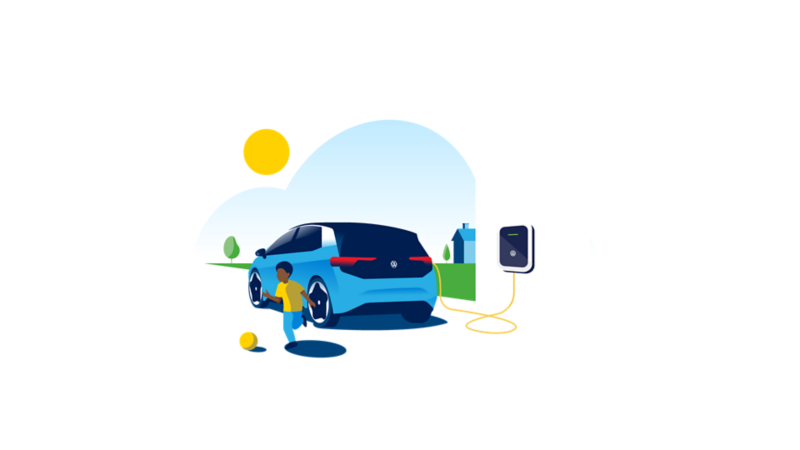
There are two different types of charging.
AC Charging
Charging is also essentially divided into two types. With AC charging, the on-board AC/DC charger converts the power from the public AC grid into the required direct current.
DC Charging
With the second type of charging – DC charging – the alternating current is converted into direct current before it reaches the vehicle – for example in the charging station. The advantage of this is that it enables a higher output during charging – for example on the motorway – and this automatically reduces the time needed to charge.
There are two different types of connectors.
Plug in, charge up, unlock and disconnect – it’s as easy as that to charge your electric car. Modern electric cars will generally have two cables available for charging.
Mennekes connectors
The Mennekes connector (Type 2) is for slow charging and meets the European standard for AC charging. Most public charging stations have at least a Type 2 socket.
- AC charging with the MEB with 7 to 11 kW.
- If you have a Wallbox at home, you can recharge the vehicle every night with 11 kW. You should also be able to recharge the energy needed for commuting during your day at work.
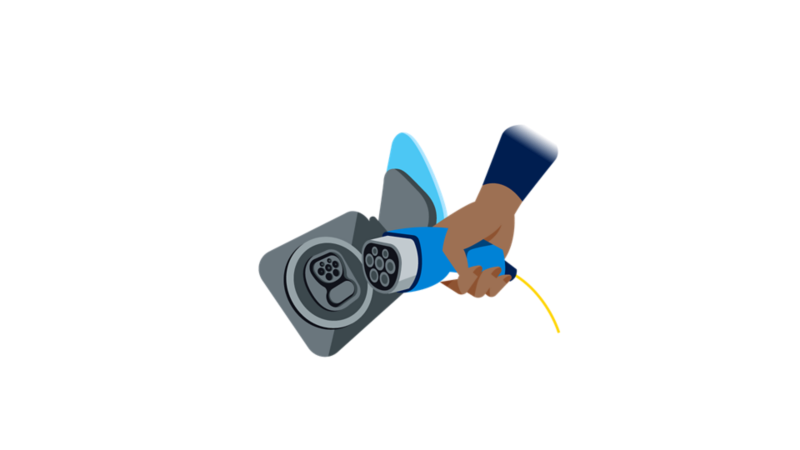
Combo 2 connectors
In Europe, CCS charging (Combined Charging System) is the standard for rapid charging. The relevant charging connector features additional contacts for DC rapid charging. The Combo 2 connector type allows you to charge at all public charging stations with a DC charging output of 22 kW or more.

From a socket to a rapid charging station: How fast your battery charges.
Simple rule of thumb says: the higher the charging power, the faster the charging process. However, the time needed can vary considerably, depending on the battery charge state. When recharging the battery, conditions such as the ambient temperature or the battery temperature also play a role. If, for example, you charge your ID.3 at a domestic socket, you can cover your daily needs with a convenient overnight charge at 2,3 kW per hour. A Wallbox or AC charging station is faster.
The fastest way to charge is to use High Power Charging (HPC) stations with a charging output of 100 kW or more. In general, we recommend that you do not charge your electric car fully every day. This protects the battery.


